
Act in the First 48 Hours: Domestic Violence Bail Conditions and Steps

Act in the First 48 Hours: Domestic Violence Bail Conditions and Steps
If you’re released after a domestic violence arrest, that release almost always comes with binding conditions, most commonly a no-contact order, stay-away provisions, and often firearm surrender or electronic monitoring. Breaking any of them can send you straight back to jail. Get the exact written order of the conditions the court imposed and contact a defense lawyer or a trusted bail agent right away. Those two steps, done in the first hours, shape everything that follows.
TL;DR:
- Bail conditions often include no-contact orders, firearm surrender, electronic monitoring, and substance restrictions, with strict enforcement and consequences for violations.
- Courts impose higher restrictions in domestic violence cases due to statutory requirements prioritizing victim safety, including mandatory hold periods and victim notification.
- Modifying bail conditions requires concrete proof like employment plans or treatment enrollment, and court hearings are more challenging than in non-domestic cases.
- Violating bail conditions triggers immediate re-arrest, bond revocation, and higher bail, with victims and monitoring alerts acting as enforcement triggers.
- A bail agent can post bond quickly but cannot alter conditions set by the court; coordinating legal advice and compliance is essential for ongoing case management.
Table of Contents
- What Happens at a Domestic Violence Bail Hearing
- Common Bail Conditions in Domestic Violence Cases
- Why Courts Impose Stricter Conditions in Domestic Cases
- How to Challenge or Modify Bail Conditions
- What Happens If You Violate Bail Conditions
- Staying Compliant While Your Case Is Pending
- What a Bail Agent Can (and Can’t) Do for You
- Need a Bond Posted Right Now?
- Sources
What Happens at a Domestic Violence Bail Hearing
Most domestic violence arrests trigger a mandatory hold before anyone sees a judge. Many jurisdictions build in a cooling-off period, often 12 to 48 hours, before a bond hearing happens, and that hearing itself typically follows within another 24 to 48 hours of booking. That’s not a technicality. It’s a deliberate pause meant to let tempers cool and give courts time to assess risk before releasing someone back into the same household or neighborhood as the alleged victim.
The hearing itself is not a full trial. It’s a focused session where a judge or magistrate decides whether release is appropriate and, if so, on what terms. Several people are typically in the room:
- The judge or magistrate presiding over the hearing
- The prosecutor, arguing for conditions or against release
- Defense counsel, if retained at that point
- The alleged victim, who may be notified and can appear or submit a statement
Under statutes like Minnesota’s §629.72, judges are required to weigh specific factors before setting terms: danger to the victim and the public, flight risk, criminal history, access to weapons, and the severity of the alleged conduct. These aren’t vague guidelines. Many jurisdictions require the judge to state findings on the record explaining why particular conditions were chosen.
Once conditions are set, the court issues a written order for conditional release. Read it closely the moment you get it. It names exactly what you can and cannot do, and it usually specifies which agency, whether that’s the sheriff’s department, probation, or a monitoring company, is responsible for enforcing each term.
Common Bail Conditions in Domestic Violence Cases
Courts draw from a fairly predictable menu of conditions in domestic violence cases, and each one carries real consequences if you misread it. Under statutes governing crimes of domestic violence and pretrial release, the most common conditions include:
- No-contact and stay-away orders. These bar direct contact (calls, texts, showing up in person) and indirect contact (messages through friends, family, or social media). The stay-away portion often names specific locations, like the victim’s home, workplace, or a child’s school, that you must avoid entirely, regardless of whether the victim is there.
- Firearm surrender. You’ll typically be required to hand over any firearms, sometimes within a set number of days, to law enforcement or a licensed dealer. Federal law can independently prohibit firearm possession while a protective order is active, separate from whatever the state court orders.
- Electronic monitoring and GPS tracking. Ankle monitors enforce curfews and geographic boundaries and alert authorities the moment you cross a line you shouldn’t. Courts must generally state the legal basis for imposing monitoring and review its necessity periodically rather than leaving it in place indefinitely.
- Substance restrictions. Abstaining from alcohol or drugs, sometimes verified through testing, is common when substance use was a factor in the alleged incident.
- Mandatory programs and check-ins. Batterer intervention programs, counseling, and scheduled check-ins with a pretrial services officer round out the typical package.
Pro Tip: Keep a dated log of every check-in, program session, and payment you make. Judges reviewing compliance later care far more about a paper trail than about your word.
Electronic monitoring has a cost most defendants don’t anticipate. Daily fees for ankle monitors typically range within an amount that can add up fast over the months a case drags on, a bill that adds up fast over a case that drags on for months; budget for it the same way you’d budget for a bond premium.

Why Courts Impose Stricter Conditions in Domestic Cases
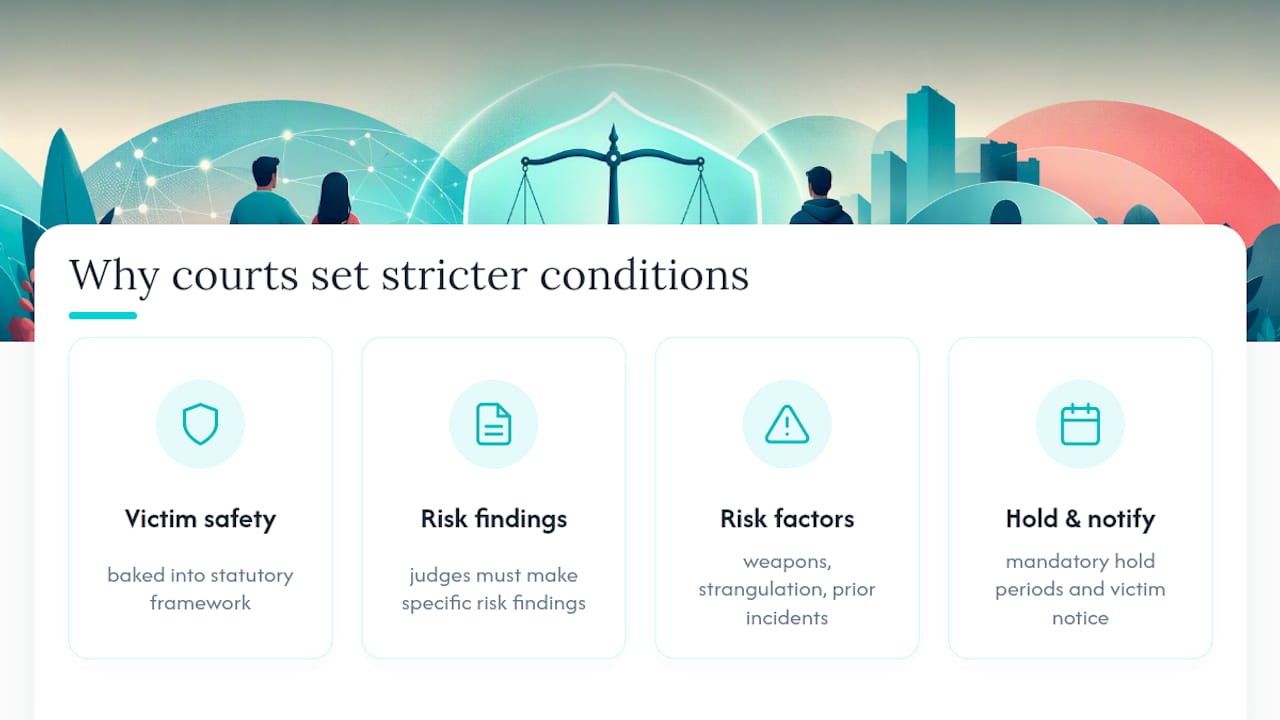
Domestic violence cases get treated differently than most other arrests because victim safety is baked into the statutory framework, not left to judicial discretion. Many states legally require judges to make specific findings about risk to the victim before setting release terms, and some mandate hold periods and victim notification as a matter of course, not judicial preference.
That’s why a judge might deny bail outright or pile on monitoring conditions when the facts involve weapons, strangulation allegations, or a documented history of prior incidents. Courts aren’t guessing at danger. They’re following a script that assumes domestic cases carry a higher risk of repeat harm than a one-off dispute between strangers, and the conditions reflect that assumption.
How to Challenge or Modify Bail Conditions
Conditions set at the first hearing aren’t necessarily permanent. Courts will revisit them when circumstances genuinely change, but you need the right approach and the right timing.
Move to modify when:
- Your job requires travel or contact that a stay-away order blocks entirely
- Parenting responsibilities conflict with a no-contact provision involving shared children
- The original conditions were broader than the facts justify
The formal path is usually a motion to modify conditions, filed by defense counsel, followed by a bond-review hearing. In urgent situations, some courts allow emergency relief on a faster timeline, though that varies by jurisdiction. What actually moves a judge is documentation: proof of stable housing, a proposed supervised visitation plan, enrollment in a treatment program already underway, and affidavits establishing you’re not a flight risk.
Pro Tip: Judges respond better to a concrete plan than to a request for less restriction. Show up with a housing address, a visitation schedule, and program enrollment paperwork, not just a request to loosen the terms.

Modification hearings in domestic cases are harder to win than in other bail contexts, and going in with realistic expectations, guided by counsel who’s handled these hearings before, matters more here than almost anywhere else in the process.
What Happens If You Violate Bail Conditions
Breaching a condition, even one that seems minor, triggers fast consequences. Expect re-arrest, bond revocation, and potentially new charges for violating a no-contact or protective order. If you’re released again after a violation, bail is often set higher the second time, and judges are far less receptive to any argument for leniency.
Violations surface through victim reports, monitoring system alerts, missed check-ins, or third-party witnesses. If you’re accused of violating a condition, contact your attorney immediately, avoid any further contact with the alleged victim no matter the circumstances, and start documenting your side, texts, call logs, anything showing what actually happened.
Staying Compliant While Your Case Is Pending
Compliance is mostly about paperwork and planning, not luck. A few concrete habits keep you out of trouble:
- Carry the written order. If work requires travel near a restricted location, show your employer or the court the actual document rather than trying to explain the restriction verbally.
- Route child contact through the court. When conditions restrict contact involving children, use court-approved exchanges or supervised third parties, never informal arrangements that could look like a violation.
- Track every monitoring payment. Keep receipts. Courts weigh consistent payment as evidence of good-faith compliance at review hearings.
- Enroll in required programs immediately. Don’t wait for a reminder. Bring proof of participation and compliance efforts to every hearing, since early enrollment reads well to a judge weighing modification later.
Pro Tip: Screenshot your program enrollment confirmation and monitoring payment receipts the day you get them. Phones die, apps glitch, and you don’t want to be scrambling for proof the morning of a hearing.
For a more detailed walkthrough of what to avoid entirely, see this breakdown of common bail condition mistakes that trip people up most often.
What a Bail Agent Can (and Can’t) Do for You
A bail agent’s job is narrow and specific: post the bond, arrange financing at the state-mandated 10% premium, and stay reachable around the clock. What an agent cannot do is touch the conditions a judge already set. No-contact orders, monitoring requirements, and program mandates come from the court, full stop.
Where a fast bond genuinely helps is timing. Getting released quickly means you can meet with counsel sooner, arrange firearm surrender promptly, and enroll in required programs before a review hearing rather than scrambling the week before. Speed buys you room to comply, not a shortcut around compliance itself.
— Jake
Need a Bond Posted Right Now?
If someone you love has been arrested on a domestic violence charge, waiting on hold music is the last thing you need. Mjbailbonds keeps real, live agents on the phone 24/7, not voicemail loops, because domestic violence holds and bond hearings don’t run on business hours, and neither should the person helping you navigate them.

The premium is a state-regulated 10%, no hidden add-ons, and Mjbailbonds offers flexible payment plans built around what a family can actually afford right now, not a one-size number. One thing worth saying plainly: posting bond gets your loved one out of custody, but it does not touch the conditions a judge has already ordered. Coordinating with a defense attorney on any modification request is still a separate, necessary step.
If you’re in Alabama, Ohio, Texas, or Florida and need a bond posted today, start with Mjbailbonds’s main line and get a live agent walking you through the next step within minutes, not hours.
This article is general information, not a substitute for advice from a qualified lawyer. Consult a qualified legal professional about your own circumstances before acting on anything here.
Sources
- § 15A-534.1 Crimes of domestic violence; bail and pretrial release (UNC School of Government materials)
- Minnesota Statutes §629.72 — Bail; domestic abuse; harassment; violation of order for protection